There’s a particular kind of tired that has nothing to do with how much sleep you got. You know the workout would help. You’ve done it before and felt better afterward. And yet the idea of putting on your shoes and moving your body feels about as realistic as running a marathon on the moon.
If you’re nodding along right now, you’re not lazy, and you’re not broken. You’re just stuck in a spot that almost everyone who’s ever tried to build a fitness habit eventually lands in.
Let’s talk about what’s actually going on when exercise feels impossible, and what you can do about it that doesn’t involve gritting your teeth and “just pushing through.”
First, Figure Out What Kind of Impossible This Is
Not all exercise resistance is the same, and treating it like it is usually backfires. There’s a difference between:
- Physical exhaustion: your body genuinely doesn’t have the energy reserves right now
- Mental burnout: you’re not tired in your muscles, you’re tired in your head
- Motivation drought: you have the energy, but the desire is nowhere to be found
- Overwhelm: the idea of a “workout” feels like too big a task to even start
- Pain or injury: something is physically stopping you, and pushing through would be a mistake
A lot of generic fitness advice assumes you’re dealing with a motivation drought, so it throws “just start, momentum will follow” type advice at you. That’s great if motivation is your actual problem. It’s terrible advice if you’re dealing with burnout or pain, where pushing harder is the opposite of what you need.
So before doing anything else, ask yourself honestly: which one of these is closest to what I’m feeling right now? The answer changes everything that follows.
When It’s Physical Exhaustion

If your body is running on empty, bad sleep, a demanding week, or recovering from illness, the kindest and smartest thing you can do is scale down, not push through. This doesn’t mean to skip entirely forever. It means lowering the bar until it’s almost embarrassingly easy.
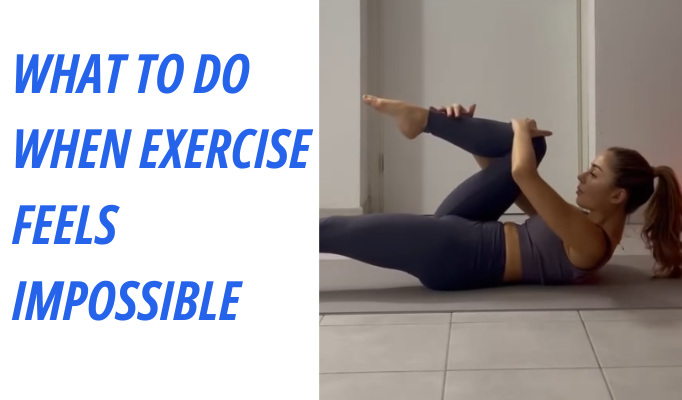
A five-minute walk counts. Stretching on your bedroom floor counts. Standing up and doing ten slow squats while you wait for coffee to brew counts. The goal in this state isn’t performance; it’s just keeping the thread connected so the habit doesn’t snap completely.
People often think rest days are the enemy of progress. They’re not. Chronic under-recovery is what actually stalls people out, often showing up as nagging fatigue, irritability, and plateaued results.
When It’s Mental Burnout
This one’s sneaky because your legs might feel fine, but the thought of exercising makes you want to lie face-down on the floor. Burnout usually comes from somewhere outside the gym, work stress, emotional load, decision fatigue, and exercise gets lumped in with “one more thing I have to do.”
The fix here often isn’t about the workout itself. It’s about removing decisions. Burned-out brains hate choices. So instead of asking “what should today’s workout be,” decide in advance, ideally the night before, exactly what you’re doing and for how long.
Even something as small as “I’m doing the same 15-minute YouTube video I always do, no thinking required” can be enough to get you moving when decision-making itself feels like the heaviest part.
Also, give yourself permission to make movement boring and repetitive for a while. Novelty is great when you have the bandwidth for it. When you don’t, predictability is a gift.
When Motivation Has Simply Vanished
Motivation is, frankly, an unreliable narrator. It shows up when it wants and disappears right when you need it most. Waiting for it to return before you move is a bit like waiting for the weather to feel like exercising before you go outside. Sometimes it just won’t cooperate.
What works better than motivation is friction reduction. Lay your workout clothes out the night before. Keep your shoes by the door instead of in the closet. If you go to a gym, pack the bag in advance so there’s no “well, I’d have to pack a bag” excuse standing between you and the door.
The two-minute rule helps here too. Commit to just two minutes. Not a workout two minutes. You can quit after that if you genuinely want to. More often than not, starting is the only hard part, and once you’re moving, stopping at two minutes feels sillier than continuing.
When the Whole Thing Feels Too Big
Sometimes the issue isn’t tiredness or lack of desire; it’s that “exercise” has ballooned into this enormous mental category that includes meal planning, the right gear, the right gym, the right program, and an hour you don’t have. No wonder it feels impossible. You’ve turned a walk around the block into a research project.
Shrink it. Don’t plan a workout; plan a single set. Don’t commit to “getting fit,” commit to one push-up. This sounds almost too small to matter, but the brain doesn’t resist small things the way it resists big ones, and small things have a funny habit of turning into bigger things once you’re already up and moving.
When It’s Actually Pain or Injury
This is the one category where pushing through is genuinely the wrong move, no matter what any motivational quote tells you. Sharp pain, swelling, or pain that gets worse with movement is your body sending a very clear message, and the right response is rest, gentle mobility work, or a visit to a doctor or physical therapist, not a pep talk.
There’s a real difference between the normal discomfort of effort and pain that signals something is wrong. If you’re not sure which one you’re dealing with, that uncertainty alone is worth checking out with a professional rather than guessing.
The Bigger Picture Nobody Tells You
Here’s something that doesn’t get said enough: consistency over years matters infinitely more than intensity on any single day. Missing a workout, or five, or even a whole month, doesn’t erase your progress the way your brain dramatically insists it does. What actually erases progress is the all-or-nothing thinking that turns one missed session into “well, I’ve ruined it, may as well stop entirely.”
The people who stay active for decades aren’t the ones who never struggle with motivation. They’re the ones who got reasonably good at doing something, anything, even on the days it felt impossible, and who stopped treating imperfect effort as failure.
So on the days exercise feels impossible, you don’t need a pep talk, and you don’t need to override your body’s signals. You need to correctly diagnose what’s actually happening, respond to that specific thing, and remember that showing up in a small, unimpressive way still counts as showing up.
FAQs
Is it okay to skip a workout if I really don’t feel like it?
Yes, completely. One skipped session has almost no effect on long-term progress. What matters is the pattern over weeks and months, not any single day. If skipping becomes a daily habit, that’s worth examining, but an occasional rest day, even an unplanned one, is normal and healthy.
How do I tell the difference between laziness and genuine burnout?
Laziness, in the way people usually use the word, doesn’t really exist as a meaningful explanation here. Ask yourself if you’ve been sleeping poorly, feeling emotionally drained, or running on stress for a while. If yes, that’s burnout or fatigue, not a character flaw. True disinterest with no underlying cause is rare; there’s almost always something behind the resistance.
Will doing a tiny five-minute workout actually do anything for me?
It does more than people expect, both physically and psychologically. Five minutes keep the habit alive, which matters more than the calories burned in that window. It also breaks the all-or-nothing pattern that causes people to quit fitness entirely after a rough week.
What should I do if exercise causes actual pain, not just discomfort?
Stop and pay attention to it rather than pushing through. Sharp, sudden, or worsening pain is different from the normal burn of effort, and it’s worth getting checked by a doctor or physical therapist rather than guessing. Continuing to train through real pain often turns a minor issue into a much longer setback.
How long does it usually take to feel motivated again after a slump?
There’s no fixed timeline, and waiting for motivation to return on its own can take a while since it isn’t very reliable. Most people find that taking small action, even something as minor as a short walk, brings motivation back faster than waiting for it to show up first. Action tends to lead the feeling, not the other way around.

I am Liam Brooks, a fitness writer passionate about simple home workouts, beginner-friendly fitness tips, and healthy daily habits. My goal is to make fitness easier, more practical, and accessible for everyone.