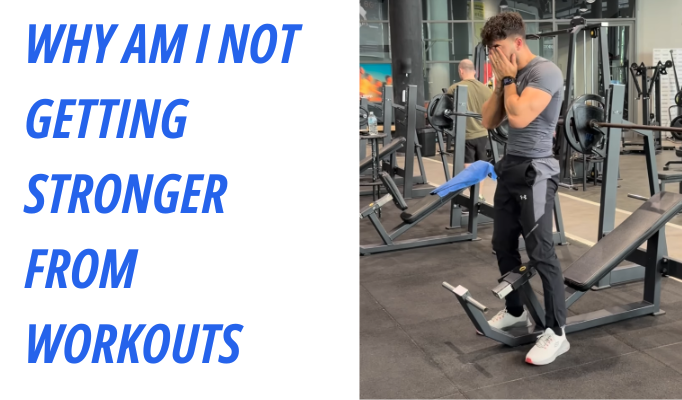
You’re showing up. You’re putting in the time. The gym bag is packed before you even think about it anymore. And yet the weights on the bar haven’t budged in weeks, maybe months. If you’re sitting there wondering why your strength has flatlined despite all that effort, you’re not alone, and you’re definitely not broken. Something in the equation is off, and it’s usually one of a handful of culprits.
You’re Not Actually Progressing Your Training

This is the big one. A lot of people walk into the gym, do “their workout,” and leave. Same weight, same reps, same exercises, week after week. Your body adapted to that stimulus a long time ago. Muscles and nervous systems get stronger because they’re forced to handle something slightly harder than what they’re used to.
If you benched 135 for three sets of eight last month and you’re still doing 135 for three sets of eight now, your body has no reason to change. It already figured out how to survive that workout.
Progressive overload doesn’t have to mean adding 10 pounds every session. It can mean an extra rep, a slower tempo, one more set, or just better form that lets you actually use the muscle you’re trying to train. The point is that something has to move forward.
You’re Not Eating Enough
Strength training is expensive in terms of energy and raw materials. If you’re chronically under-eating, especially protein, your body simply doesn’t have what it needs to repair and build tissue. A lot of people trying to “get lean and strong at the same time” end up sabotaging the strong part because they’re in too large a calorie deficit.
You can still gain strength while losing fat, but it’s a much narrower window than most people think, and it requires getting protein intake right, usually somewhere around 0.7 to 1 gram per pound of bodyweight for most lifters.
You’re Not Recovering Between Sessions
Strength isn’t built in the gym. It’s built in the hours and days after, when your body repairs the micro-damage from training. If you’re sleeping five hours a night, training the same muscle groups too frequently, or stacking stress from work and life on top of hard training, your body never gets the chance to actually adapt.
It’s stuck in a constant state of breakdown with no rebuild phase. This is one of the most underrated reasons people stall, because it has nothing to do with the workout itself.
Your Form Might Be Limiting You
Sometimes people aren’t weak; they’re just not using their muscles efficiently. If your squat depth is inconsistent, if you’re using momentum instead of control, or if your setup changes every session, you’re not training the lift consistently enough to actually get better at it.
Strength is a skill as much as it is a physical quality. Cleaning up your technique can unlock weight increases that have nothing to do with getting “stronger” in the muscular sense.
You’re Doing Too Much, Not Too Little
This one surprises people. More isn’t always better. If you’re doing five or six exercises per muscle group, training every day, and chasing soreness as a sign of progress, you might be digging a hole you can’t recover from. Junk volume adds fatigue without adding enough stimulus to justify it. Sometimes the fix for a strength plateau is doing less, but doing it harder and with more focus.
You Haven’t Given It Enough Time
Strength gains, especially after the beginner phase, slow down. That’s normal. In the first few months of training, almost anyone gets stronger fast because the nervous system is learning new movement patterns.
After that, progress becomes more gradual, and a few weeks without a personal record doesn’t mean something’s wrong. The real warning sign is months of stagnation despite consistent effort, not a slow week here or there.
What Actually Helps
If you want to break out of a plateau, the fix is rarely one dramatic change. It’s usually a combination of small corrections: tracking your lifts so you actually know if you’re progressing, eating enough protein and total calories to support recovery, sleeping closer to seven or eight hours, and picking a handful of lifts to get genuinely good at instead of constantly switching things up. Strength responds to consistency applied with intention, not just consistency alone.
FAQs
How long does it usually take to notice strength gains?
Beginners often see noticeable strength increases within the first 4 to 6 weeks, largely due to neurological adaptations rather than muscle growth itself. After that initial phase, progress slows and becomes more gradual, often measured in months rather than weeks.
Can I get stronger without gaining muscle size?
Yes, to a point. Strength gains early on come mostly from your nervous system getting better at recruiting muscle fibers and coordinating movement. Over time, though, sustained strength increases typically require some degree of muscle growth to support heavier loads.
Is it normal to plateau even when I’m training hard?
Completely normal. Plateaus happen to almost everyone, including experienced lifters. They’re usually a sign that something in training, nutrition, or recovery needs adjusting, not that you’ve hit some kind of genetic ceiling.
Does soreness mean I had a good workout?
Not necessarily. Soreness reflects unfamiliar stress on a muscle, not the quality or effectiveness of a workout. You can make excellent progress with minimal soreness once your body adapts to a routine.
Should I change my entire workout if I’m not getting stronger?
Not right away. Small adjustments, like increasing reps, improving form, or eating more protein, often solve the problem before a complete overhaul is necessary. Constantly switching programs can actually prevent the consistency that strength training depends on.

I am Liam Brooks, a fitness writer passionate about simple home workouts, beginner-friendly fitness tips, and healthy daily habits. My goal is to make fitness easier, more practical, and accessible for everyone.
1 thought on “Why Am I Not Getting Stronger From Workouts?”