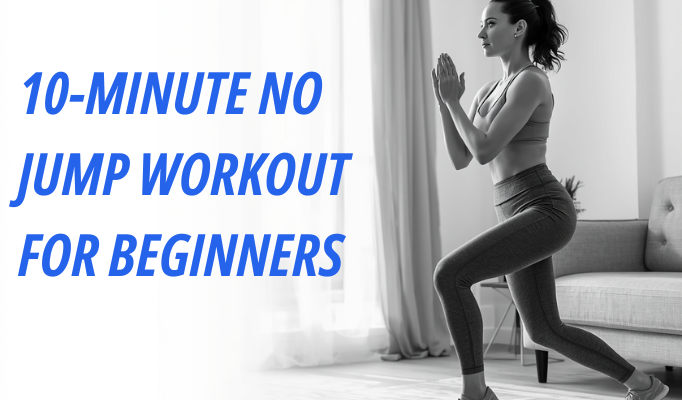
10 Minute No Jumping Workout for Beginners (That Actually Works)
No equipment, no noise, no excuses just ten minutes and a few feet of floor space between you and a stronger body.

A quiet apartment, some floor space, and ten minutes. That’s all this takes.
Let me be straight with you when I first started working out, the last thing I wanted was someone telling me to do burpees at 7 in the morning while my downstairs neighbor was still asleep.
If you live in an apartment, share a wall with someone, have bad knees, or simply hate the feeling of your body slamming into the floor repeatedly — this one’s for you. A solid 10 minute no jumping workout for beginners can do more than you think, and you don’t need to leave your bedroom to do it.
Why No-Jumping Workouts Are Actually Great for Beginners
Here’s something the fitness world doesn’t always say out loud: jumping is a skill. It puts stress on your ankles, knees, and hips in ways that your joints might not be ready for yet especially if you’ve been mostly sedentary.
Low-impact doesn’t mean low-effort. It means you’re building strength, stability, and endurance without the pounding. And honestly? That’s smarter, not easier.
These workouts are especially good if you:
- Live in an apartment or shared space
- Have joint sensitivity or minor knee pain
- Are just starting out and want to ease in
- Work out early mornings or late nights without waking anyone up
- Are coming back from a long break
What You’ll Need
Nothing fancy. Clear about 6 feet of floor space, wear comfortable clothes, and keep some water nearby. That’s it. No equipment, no gym membership, no excuses.
The 10 Minute No Jumping Workout
Do each exercise for 45 seconds, rest for 15 seconds, then move to the next. Complete the circuit once. If you feel up to it after a few weeks, run through it twice.
March in Place (Warm-Up)
45 sec · Rest 15 sec
Start slow. Lift your knees to hip height, swing your arms naturally, and just get the blood moving. This isn’t a race — it’s a warm-up. Two minutes of this wakes your body up better than most people expect.
Bodyweight Squats
45 sec · Rest 15 sec
Stand with your feet shoulder-width apart. Send your hips back like you’re about to sit in a chair that’s just a little too far behind you. Go as low as feels comfortable even a quarter squat counts when you’re starting out.
Standing Side Steps
45 sec · Rest 15 secStep your right foot out, bring your left foot to meet it. Then step left, bring the right foot in. Keep your chest up and add a small bend in the knees to get your glutes involved.
It looks simple. After 45 seconds, you’ll feel it in your outer hips and thighs.
Push-Ups (Wall or Floor Your Call)
45 sec · Rest 15 sec
If you’re brand new, wall push-ups are completely legitimate. Stand arm’s length from a wall, place your palms flat, and lower your chest toward the wall. If you’re comfortable on the floor, start from your knees.
Standing Glute Kickbacks
45 sec · Rest 15 sec
Hold the back of a chair for balance if you need it. Shift your weight to one leg, and slowly kick the other leg straight back, squeezing your glute at the top. Bring it back without letting it touch the floor.
Slow Mountain Climbers
45 sec · Rest 15 sec
Get into a plank position (on your hands, body in a straight line). Bring one knee toward your chest — slowly. Then switch. If regular mountain climbers feel too fast or intense, this version does the same job without the chaos.
Seated Leg Raises (Chair or Floor)
45 sec · Rest 15 sec
Sit on the edge of a sturdy chair with your back straight. Extend one leg until it’s parallel to the floor, hold for a second, then lower it slowly. Alternate sides.
Standing Oblique Crunches
45 sec · Rest 15 sec
Stand with your feet hip-width apart, hands behind your head. Lift your right knee while bringing your right elbow down to meet it. Alternate sides in a slow, controlled rhythm.
Calf Raises
45 sec · Rest 15 sec
Hold a wall or chair for balance. Rise up on your tiptoes, hold for a beat at the top, then lower slowly. Simple, but your calves will remind you they exist by the end.
Slow Deep Breathing + Stretch (Cool-Down)
60–90 seconds
Don’t skip this. Take 60–90 seconds to roll your shoulders, reach your arms overhead, fold forward gently, and breathe. Your heart rate comes down, your muscles start to recover, and honestly — it just feels good.
What to Expect in Your First Week
Day one might feel too easy. Day two, you might feel muscles you forgot you had. That’s completely normal. Consistency is what makes this work, not intensity.
Try doing this workout 3 times in your first week. By week three, you’ll probably want to run through the circuit twice. That’s how progress happens quietly and steadily.
A Few Things Worth Knowing
You will feel soreness. Not pain, but that dull ache that tells you something worked. Drink water, sleep, and give yourself a rest day.
Slower is often harder. If an exercise feels too easy, slow down the movement. You’ll feel the difference immediately.
Modify everything. Every single exercise in this routine can be made easier or harder depending on where you are. There’s no shame in using a chair for balance or doing half the reps. The goal is to finish, not to perform.
Final Thought
The best workout is the one you’ll actually do. A 10 minute no jumping workout for beginners isn’t a consolation prize it’s a starting point. And starting is everything.
Give it a few weeks. Be consistent, be patient, and don’t compare your day one to someone else’s year two. You’ll be surprised where you end up.

I am Liam Brooks, a fitness writer passionate about simple home workouts, beginner-friendly fitness tips, and healthy daily habits. My goal is to make fitness easier, more practical, and accessible for everyone.