So you moved into an apartment, or maybe you’ve been in one for years, and at some point you decided you wanted to work out at home. Great idea, honestly. No commute, no waiting for machines, no awkward eye contact with strangers.
Then you jumped.
And your downstairs neighbor knocked on the ceiling with what sounded like a broom handle.
Yeah. Welcome to apartment fitness.
The good news is that you don’t actually need to jump, stomp, or make any sound at all to get a serious cardio workout. This isn’t about doing a watered-down version of real exercise. It’s about learning how to move in a way that keeps your heart rate up, your neighbors sane, and your lease intact.
Why Most “Quiet Workouts” Still Aren’t Quiet
Here’s what bugs me about a lot of apartment workout advice online: they tell you to swap jumping jacks for “low-impact jumping jacks” and act like that solves the problem. It doesn’t. Any movement where your full bodyweight drops onto a floor transfers vibration. Doesn’t matter how soft you try to land.
The real solution isn’t softer landings. It’s removing impact almost entirely.
That means thinking about cardio differently. Instead of elevation changes up, down, up, down, you focus on continuous muscle tension, controlled movement, and speed of repetition. Your heart rate goes up because your muscles are working hard, not because gravity is slamming you into the floor every two seconds.
What You Actually Need
Almost nothing. A yoga mat helps not for cushioning (it won’t help much with noise) but to give your feet grip so you’re not shuffling around on hardwood. That’s it.
You don’t need a stationary bike, a quiet treadmill, or a thick foam mat (though a thicker mat does help with noise transmission somewhat if you have the budget).
Most of this you can do in a 6×6-foot space.
The Workout
This is a 25–30 minute circuit. Go through all six exercises back to back, rest 60–90 seconds, then repeat 3 times. If you’re new to this, two rounds are fine.
1. Standing Core Twists 45 seconds
Stand with feet shoulder-width apart, arms out in front of you or hands clasped. Rotate your torso left and right, fast. Think of it like you’re trying to look over your shoulder repeatedly at something that keeps moving.
This sounds too easy. It isn’t. Do it fast, keep your hips mostly square, and you’ll feel your obliques and your heart rate wake up within about 20 seconds.
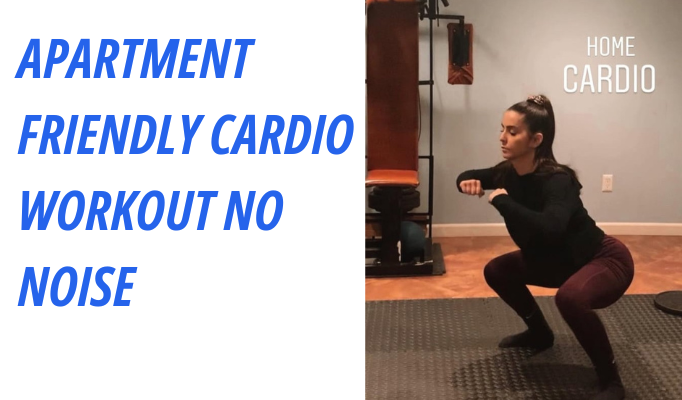
2. Squat Pulses 40 seconds
Get into a squat position, thighs roughly parallel to the floor, and just pulse. Small movements, up and down, maybe two or three inches. Don’t stand up fully. Stay low.
Your legs will start burning embarrassingly fast. That burn is your muscles working, which means your cardiovascular system is working to support them. No impact. No noise. Just suffering, quietly.
3. Bear Crawl Hold with Shoulder Taps 40 seconds
Get into a push-up position. Instead of doing push-ups, just hold there and alternate tapping your opposite shoulders, right hand to left shoulder, left hand to right shoulder.
Move fast. Keep your hips as still as possible (they’ll want to rock — resist that). This one hits your core, your shoulders, and because you’re fighting to stay stable, it’s surprisingly taxing.
4. Slow Mountain Climbers 45 seconds
Yes, mountain climbers. But slow ones.
Start in the same push-up position. Drive one knee toward your chest, hold for a half-second, return it, then the other knee. Make it deliberate. Three seconds per rep, maybe.
Slow mountain climbers are not easier than fast ones; they’re harder, actually, because your core is under tension longer. And they make almost no sound.
5. Standing Bicycle 50 seconds
Stand up. Hands behind your head, elbows wide. Bring your right knee up while rotating your left elbow toward it. Then alternate. Like a standing crunch with a twist.
The key is height on the knee, really drive it up, and actually rotating through your torso, not just bobbing your elbow down. Done properly, this is genuinely challenging cardio. Done lazily, it’s a stretch. You decide which one you need.
6. Wall Sit with Arm Circles 45 seconds
Back against the wall, thighs parallel to the floor. Hold it. While you’re there, extend your arms and make circles forward for 20 seconds, backward for the rest.
Your legs are doing isometric work the entire time. Your shoulders are complaining. Your heart is working to supply blood to all of it. Zero impact. Zero noise.
A Few Things Worth Knowing
Time of day matters less than you think. If you’re doing the above, you can probably do it at 11 pm without anyone noticing. But if your building has older construction, sound travels unpredictably. If you know your neighbor works nights and sleeps days, be considerate. It costs nothing.
Controlled breathing makes a difference. When people get tired, they start stomping around subconsciously — shifting weight, pacing, dropping into movements. Focusing on your breath keeps you deliberate.
Progression looks different here. With impact cardio, you progress by jumping higher or moving faster. With this, you progress by reducing your rest time, increasing your rounds, or slowing down your reps to increase time under tension. A slower squat pulse is harder than a fast one.
It’s not forever. If you ever want to do HIIT with jumping, find a nearby park or gym for those sessions. Low-impact home workouts are a tool, not a prison sentence.
The Honest Truth About Apartment Cardio
Most people who live in apartments and “can’t work out at home” haven’t actually tried this kind of training; they’ve just tried to copy gym workouts in a smaller space and then gotten frustrated or self-conscious about the noise.
This is different. It takes a few sessions to feel natural, but once it clicks, you realize you’ve had a gym this whole time. It’s just quiet.
Your downstairs neighbor will never know. And honestly, they don’t need to.

I am Liam Brooks, a fitness writer passionate about simple home workouts, beginner-friendly fitness tips, and healthy daily habits. My goal is to make fitness easier, more practical, and accessible for everyone.