So you’ve decided to start working out. Maybe you bought a gym membership last January, used it twice, and quietly let it expire. Or maybe you’ve just never really started, you keep telling yourself you’ll begin “next Monday.”
Here’s the thing: you don’t need a gym. You don’t need a rack of dumbbells or a personal trainer or a fancy mirror that talks to you. Your body weight and a patch of floor space are genuinely enough to build a real fitness foundation, especially when you’re just starting out.
This guide is for people at the very beginning, no judgment, no pretending you already know what a “superset” is.
Before You Jump In
A quick reality check first.
Full body workouts are ideal for beginners because they hit every major muscle group in one session, which means you get more done in less time and your body learns movement patterns faster. You’re not ready to split your training into “leg day” and “push day” yet, and honestly, you don’t need to be.
Aim for 3 days a week, with at least one rest day between sessions. So Monday, Wednesday, and Friday work well. Saturday, Tuesday, and Thursday work too. The exact days don’t matter nearly as much as the consistency.
And yes, rest days are part of the program. Your muscles don’t grow during the workout. They grow while you’re resting.
The Workout
No equipment needed. Do each exercise back to back, rest for 60–90 seconds after completing all of them, then repeat for 2–3 rounds total.
1. Bodyweight Squats 12 reps
Stand with your feet about shoulder-width apart, toes pointing slightly outward. Sit back and down like you’re lowering yourself onto a chair that’s a little farther back than you expect. Keep your chest up, don’t let your knees cave inward, and push through your heels to stand back up.
If your heels keep lifting off the ground, try widening your stance or pointing your toes out a bit more. This is your legs and glutes doing the bulk of the work.
2. Push-Ups 8–10 reps (or as many as you can with good form)
Hands slightly wider than shoulder-width, body in a straight line from head to heels. Lower your chest to the floor, then push back up.
Can’t do a full push-up yet? Totally fine. Drop to your knees. It’s not a modification to be embarrassed about; it’s just a scaled version of the same movement. Build from there.
3. Glute Bridges 12 reps
Lie on your back with your knees bent and feet flat on the floor, hip-width apart. Drive your hips up toward the ceiling by squeezing your glutes, hold for a second at the top, then lower back down slowly. Don’t rush through these; the squeeze at the top is where the work happens.
4. Plank 20–30 seconds
Forearms on the ground, elbows under your shoulders, body in a straight line. Brace your core like someone’s about to poke you in the stomach. Don’t let your hips sag or shoot up.
If 20 seconds feels easy, push to 30 or 40. If it feels impossible, start with 10 and work up. That’s completely normal.
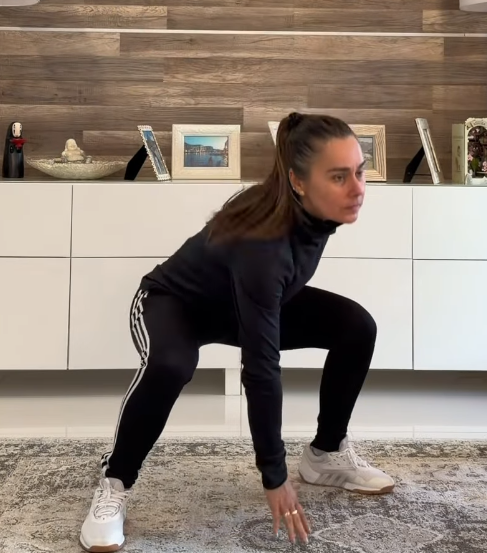
5. Reverse Lunges 10 reps per leg
From standing, step one foot back and lower your back knee toward the floor. Your front knee should be roughly over your ankle, not diving past your toes. Push through your front heel to return to standing. Repeat on the other side.
Reverse lunges are generally easier on the knees than forward lunges, which is why they’re here instead.
6. Superman Hold 10 reps
Lie face down on the floor, arms stretched out in front of you. Lift your arms, chest, and legs off the ground at the same time, hold for 2 seconds, then lower. It looks a little silly, but this is great for your lower back and posterior chain, the muscles that keep you upright and prevent the kind of back pain that comes from sitting at a desk all day.
How to Progress Over Time
The biggest mistake beginners make is doing the exact same workout for months and wondering why nothing is changing. Your body adapts. That’s actually the goal, but once it adapts, you need to give it a new challenge.
A few simple ways to make the workout harder as you improve:
- Add reps. If 12 squats feel easy, do 15. Then 20.
- Add rounds. Start with 2 rounds, work up to 3 or 4.
- Slow down the tempo. A slow squat (3 seconds down, 1 second up) is significantly harder than a fast one.
- Reduce rest time. Going from 90 seconds to 60 seconds rest makes the whole workout more demanding without changing a single exercise.
- Try harder variations. Regular push-ups mastered? Try pike push-ups. Squats feeling easy? Try jump squats.
You don’t need to progress every single week. But every few weeks, ask yourself if the workout is still challenging. If the honest answer is no, change something.
What to Eat (The Short Version)
You could write a book on nutrition, and many people have, some of them contradicting each other entirely. For a beginner, you really don’t need to overthink it.
Eat enough protein. Somewhere in the range of 0.7 to 1 gram per pound of body weight per day is a solid target for someone trying to build muscle and get stronger. Chicken, eggs, Greek yogurt, cottage cheese, lentils, and tofu are all good options.
Don’t skip meals because you worked out. Especially when you’re just starting, your body needs fuel to recover.
And drink water. Sounds obvious, but most people are mildly dehydrated most of the time. It affects everything: energy, focus, and recovery.
The Stuff Nobody Tells You
You will be sore after the first session. Maybe after the first two or three. That muscle soreness, delayed onset muscle soreness, or DOMS, is normal. It’s not an injury. It’s just your body responding to a new stimulus.
The soreness gets better. By week three or four, you’ll barely feel it after a session. That doesn’t mean the workout stopped working; it means your body is adapting.
Some days you won’t want to work out. That’s fine. Do it anyway, at least most of the time. The motivation you’re waiting for usually shows up after you start, not before.
And don’t compare yourself to wherever you imagine everyone else is. Someone’s been training for five years. Someone else lost 40 pounds before you ever saw their Instagram. Your starting point is your starting point; it doesn’t define your ceiling.
A Sample Weekly Schedule
| Day | What to Do |
|---|---|
| Monday | Full Body Workout (2–3 rounds) |
| Tuesday | Rest or light walk |
| Wednesday | Full Body Workout (2–3 rounds) |
| Thursday | Rest or light walk |
| Friday | Full Body Workout (2–3 rounds) |
| Saturday | Active rest — stretch, walk, whatever you enjoy |
| Sunday | Full rest |
Light walking on rest days counts as active recovery; it helps with soreness without putting more stress on your muscles.
Final Thought
The best workout is the one you’ll actually do. This one requires zero equipment, takes about 25–30 minutes, and will build a genuine base of strength if you stick with it for a few months.
Start. Adjust as you go. Don’t wait until you feel ready; that feeling rarely comes before you begin.

I am Liam Brooks, a fitness writer passionate about simple home workouts, beginner-friendly fitness tips, and healthy daily habits. My goal is to make fitness easier, more practical, and accessible for everyone.